

 Image 1 of 1
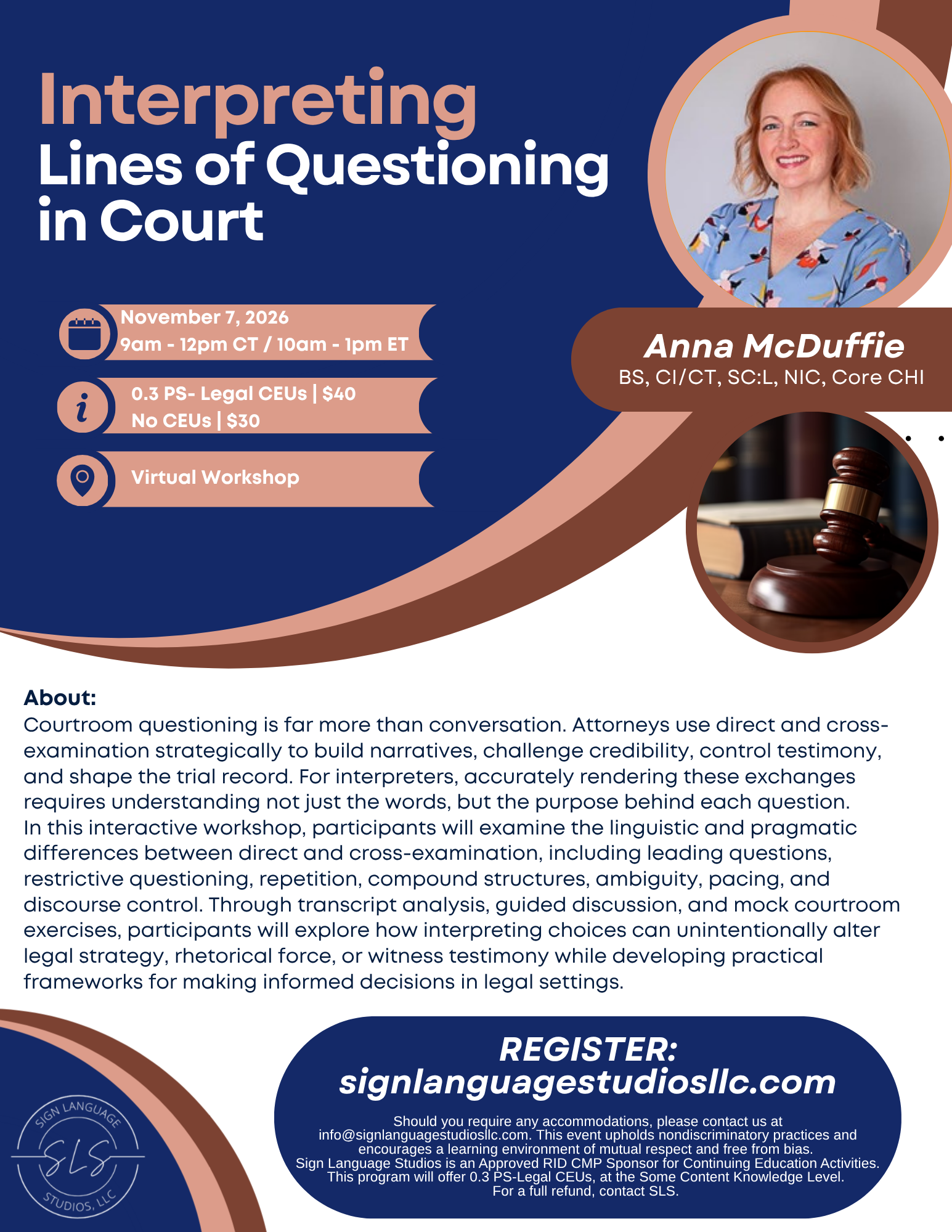
Interpreting Lines of Questioning in Court
Presented by Anna McDuffie, BS, CI/CT, SC:L, NIC, Core CHI
November 7, 2026
9am - 12pm CT / 10am - 1pm ET
0.3 PS CEUs
Presented in English
Workshop Description:
Courtroom questioning is not conversation. Attorneys use direct examination and cross-examination strategically to build narrative, control testimony, establish credibility, challenge inconsistencies, and shape the trial record. Although the English words may appear similar across question types, the function, pressure, and communicative goals behind those questions are often completely different.
For sign language interpreters, accurately rendering courtroom questioning requires more than vocabulary equivalence. It requires recognizing what each question is designed to accomplish.
This interactive workshop examines the linguistic and pragmatic differences between direct examination and cross-examination, including leading questions, restrictive questioning, repetition as strategy, compound structures, ambiguity, pacing, and discourse control. Participants will analyze how attorneys structure questioning to influence witness responses and how interpreting choices may unintentionally alter rhetorical force, narrative restriction, or legal meaning.
Through transcript analysis, guided discussion, and mock courtroom exercises, participants will explore the tension between preserving natural ASL discourse structure and preserving legal strategy during interpreted courtroom interactions. Special attention will be given to the interpreter’s role in maintaining tone, restriction, repetition, and ambiguity without unconsciously softening, clarifying, or restructuring testimony.
This workshop is designed for interpreters currently working in or preparing for legal settings and will provide practical frameworks for analyzing courtroom discourse and making informed interpreting decisions in high-stakes environments.
Courtroom language is strategic language. The interpreter is not interpreting conversation — they are interpreting legal strategy.
Educational Objectives:
By the end of this workshop, participants will be able to:
Differentiate between direct examination and cross-examination by identifying their linguistic structures and strategic functions.
Identify leading, restrictive, repetitive, compound, and ambiguous questioning structures commonly used during cross-examination.
Analyze how courtroom questioning strategies influence narrative control, witness response patterns, and discourse restriction.
Apply the Four Preservations framework (tone, restriction, repetition, and ambiguity) to sample courtroom interpreting scenarios.
Compare how different interpreting choices may alter rhetorical force, communicative pressure, or legal meaning during courtroom questioning.
Recognize situations in which clarification, contextual weaving, or answer-form specification may unintentionally alter legal discourse strategy.
DISCLAIMER:
Should you require any accommodations, please contact us at kayla@signlanguagestudiosllc.com.
This event upholds nondiscriminatory practices and encourages a learning environment of mutual respect and free from bias. Sign Language Studios is an Approved RID CMP Sponsor for Continuing Education Activities. This program will offer 0.3 PS-legal CEUs, at the Some Content Knowledge Level.
For a full refund, contact SLS.
Presented by Anna McDuffie, BS, CI/CT, SC:L, NIC, Core CHI
November 7, 2026
9am - 12pm CT / 10am - 1pm ET
0.3 PS CEUs
Presented in English
Workshop Description:
Courtroom questioning is not conversation. Attorneys use direct examination and cross-examination strategically to build narrative, control testimony, establish credibility, challenge inconsistencies, and shape the trial record. Although the English words may appear similar across question types, the function, pressure, and communicative goals behind those questions are often completely different.
For sign language interpreters, accurately rendering courtroom questioning requires more than vocabulary equivalence. It requires recognizing what each question is designed to accomplish.
This interactive workshop examines the linguistic and pragmatic differences between direct examination and cross-examination, including leading questions, restrictive questioning, repetition as strategy, compound structures, ambiguity, pacing, and discourse control. Participants will analyze how attorneys structure questioning to influence witness responses and how interpreting choices may unintentionally alter rhetorical force, narrative restriction, or legal meaning.
Through transcript analysis, guided discussion, and mock courtroom exercises, participants will explore the tension between preserving natural ASL discourse structure and preserving legal strategy during interpreted courtroom interactions. Special attention will be given to the interpreter’s role in maintaining tone, restriction, repetition, and ambiguity without unconsciously softening, clarifying, or restructuring testimony.
This workshop is designed for interpreters currently working in or preparing for legal settings and will provide practical frameworks for analyzing courtroom discourse and making informed interpreting decisions in high-stakes environments.
Courtroom language is strategic language. The interpreter is not interpreting conversation — they are interpreting legal strategy.
Educational Objectives:
By the end of this workshop, participants will be able to:
Differentiate between direct examination and cross-examination by identifying their linguistic structures and strategic functions.
Identify leading, restrictive, repetitive, compound, and ambiguous questioning structures commonly used during cross-examination.
Analyze how courtroom questioning strategies influence narrative control, witness response patterns, and discourse restriction.
Apply the Four Preservations framework (tone, restriction, repetition, and ambiguity) to sample courtroom interpreting scenarios.
Compare how different interpreting choices may alter rhetorical force, communicative pressure, or legal meaning during courtroom questioning.
Recognize situations in which clarification, contextual weaving, or answer-form specification may unintentionally alter legal discourse strategy.
DISCLAIMER:
Should you require any accommodations, please contact us at kayla@signlanguagestudiosllc.com.
This event upholds nondiscriminatory practices and encourages a learning environment of mutual respect and free from bias. Sign Language Studios is an Approved RID CMP Sponsor for Continuing Education Activities. This program will offer 0.3 PS-legal CEUs, at the Some Content Knowledge Level.
For a full refund, contact SLS.